ECU Faults in Vans: Why Peugeot, Fiat and Citroën Need Specialist Diagnostic
This post explains how the ECU controls critical systems in Peugeot, Fiat and Citroën commercial vans, why faults in those systems are often missed by generic scan tools, and what specialist diagnostics actually involves. Written for Brisbane van owners and fleet operators who want to understand what is happening inside their vehicle before a warning light forces the issue.
Modern commercial vans are not just mechanical machines anymore. Engine performance, fuel delivery, emissions management, turbo control, transmission behaviour and battery charging are all managed electronically. At the centre of it all sits the ECU (Engine Control Unit), along with a network of connected modules that communicate constantly across the vehicle.
When something starts going wrong in that network, the symptoms are not always obvious. A warning light might appear briefly, then clear. Fuel consumption might creep up over several weeks without any clear explanation. The van might occasionally feel sluggish under load. These early signs are easy to attribute to something else, or simply ignore, because the vehicle is still drivable.
That is where the problem tends to compound. For Brisbane trades and fleet operators running these vehicles daily, delayed diagnostics almost always mean larger repair bills. European vans in particular need specialist attention because their electronic systems are more deeply integrated than most owners realise. Basic scan tools do not give you the full picture, and in many cases they do not even come close.
Modern Vans Rely More on Electronics Than Most Owners Realise
Older commercial vans were largely mechanical. Diagnosis was straightforward: a trained eye, some experience, and the right tools. Modern Peugeot, Fiat and Citroën vans are fundamentally different. The ECU does not just manage engine timing. It oversees an interconnected architecture of control modules, each responsible for a different vehicle system, all of them in constant electronic communication.
A fault in one module can affect the behaviour of several others. This is not a design flaw. It is the natural result of building vehicles that are more efficient, cleaner and more capable than anything that came before them. But it does mean that when something goes wrong, the diagnostic process needs to be capable of reading that entire network, not just the most obvious fault code on the surface.
How ECU Systems Control Daily Vehicle Performance
The ECU manages fuel injection timing, turbo boost pressure, throttle response, transmission communication, emissions control, engine temperature and battery charging, among other functions. It receives data from dozens of sensors simultaneously and adjusts vehicle behaviour in real time. On the PSA platform shared by the Peugeot Boxer, Citroën Relay and Fiat Ducato, that architecture is particularly tightly integrated.
When a sensor reading drifts outside its expected range, the ECU logs a fault code and may adjust operating parameters to compensate. The vehicle might continue running, but it will not be running correctly. Fuel trim values shift, injection timing changes, and the cumulative effect on fuel consumption, emissions and component wear builds quietly in the background.
Why European Vans Are More Electronically Complex
European commercial vans have consistently led the field on emissions compliance, fuel efficiency and safety integration. That is partly why they hold up so well under demanding commercial use. It is also why their diagnostic requirements are more demanding than older or simpler platforms. The PSA architecture uses proprietary software protocols, including Diagbox and Planet software for Peugeot and Citroën, that go well beyond what a standard OBD2 reader can access.
A generic scan tool reads surface-level fault codes. It cannot access BSI (Body Systems Interface) module data, ECU programming functions, or the deeper fault layers that these vehicles hold. A van can pass a generic scan and still be carrying multiple developing faults that only reveal themselves with the right equipment.
What Happens When ECU Communication Fails
When communication between modules breaks down, the effects cascade. An intermittent sensor fault might cause the ECU to miscalculate fuel delivery. That leads to incomplete combustion, which increases soot load on the DPF. The DPF starts restricting exhaust flow, which puts additional back pressure on the turbo. The turbo runs hotter than it should, and oil contamination risk increases.
This kind of chain reaction is common in vans that have been running with unresolved warning lights. Each system tries to compensate for the next, and the actual source of the problem becomes harder to isolate the longer it goes unaddressed.
The Queensland Breakdown Picture
To understand why ECU diagnostics matter for fleet operators, it helps to look at the breakdown data. RACQ responded to 755,000 roadside rescue calls across Queensland in FY2023, an average of 87 jobs every hour. Battery-related issues were the single largest callout category, ahead of flat tyres and lockouts.
Battery management in a modern diesel van is not a standalone system. It is managed and monitored through the ECU. When the ECU is not reading battery state correctly, or when a module is drawing parasitic current it should not be, the battery drains in ways that are difficult to diagnose without the right equipment. Many roadside battery callouts on European vans are the downstream result of an unresolved ECU or module fault, not a battery that has simply reached the end of its life.
Common ECU Problems Found in Peugeot, Fiat and Citroën Vans
ECU faults in these vans tend to cluster around a handful of recurring patterns. Understanding what they are, and how they present, is the first step toward catching them before they escalate.
| Fault Type | Common Presentation | System Affected | Risk if Ignored |
|---|---|---|---|
| Sensor communication error | Intermittent warning light, clears on its own | ECU, BSI module | Cascading faults across connected systems |
| DPF regeneration failure | Power loss, warning light, increased fuel use | Emissions, ECU | DPF replacement, turbo back pressure damage |
| AdBlue system fault | Warning light, limp mode after threshold | SCR system, ECU | Vehicle immobilisation after repeated starts |
| Battery management fault | Slow starting, electrical inconsistencies | ECU, charging circuit | Roadside battery failure, false sensor codes |
| Turbo pressure irregularity | Sluggish acceleration, smoke under load | Turbo, ECU, boost sensor | Turbo damage, oil contamination |
| Injector calibration drift | Rough idle, increased fuel consumption | Fuel system, ECU | Injector failure, uneven combustion wear |
Engine Warning Lights That Keep Returning
A warning light that clears itself is not a problem that has resolved. It is a problem that has gone intermittent. The fault code that triggered it is almost certainly still stored in the ECU. Intermittent faults are often harder to diagnose after the fact because the conditions that triggered them may not be present when the vehicle is scanned. The longer the gap between the fault occurring and a proper diagnostic scan, the less data is available to work with.
DPF and Emissions System Errors
DPF faults are among the most common ECU-related issues in urban fleet vans on this platform. The ECU monitors soot load continuously and initiates regeneration cycles when the threshold is reached. If the vehicle's operating conditions prevent a successful regeneration (short trips, low exhaust temperatures, stop-start driving), the soot load climbs until the ECU logs a fault. Fault code P2463 is the standard DPF restriction code on PSA platform vehicles.
The complication is that DPF faults rarely exist in isolation. By the time a DPF fault is severe enough to trigger limp mode, the EGR system, turbo back pressure, and fuel trim values are usually all affected. A surface-level scan that clears the DPF code without addressing those upstream issues will result in the same fault returning within days.
Transmission and Turbo Performance Faults
Transmission communication faults and turbo pressure irregularities both present similarly from the driver's seat: the van feels sluggish, hesitant, or inconsistent under load. Without live data from the ECU, separating a turbo boost sensor fault from a genuine turbo problem, or a transmission communication error from a mechanical issue, is difficult. The scan tool has to be capable of reading live parameter data from both the engine ECU and the transmission module simultaneously to give a clear picture.
By the time a driver notices something feels off, the ECU has often been logging fault codes for weeks. A disappearing warning light is not a fix. It is the fault going quiet until conditions repeat.
Why Generic Scan Tools Often Miss the Real Problem
This is one of the most important things for Brisbane van owners to understand. A generic OBD2 reader, including the kind available at most auto parts stores, reads standardised universal fault codes. That is useful for a basic check, but it represents a fraction of the data these vehicles actually hold.
Peugeot and Citroën vans require Diagbox or Planet software for full access. Fiat Ducato diagnostics require Multiecuscan or equivalent manufacturer-level tools. Without these, a workshop is looking at maybe 30 to 40 percent of the available fault data. The deeper fault layers, module communication logs, live data streams, and calibration status, remain invisible.
A generic scanner gives you the warning light codes. Manufacturer-level diagnostics tell you why those codes are there, what triggered them, and whether something else is developing alongside them. They are entirely different conversations.– Neville Wall, East Coast Commercial Service Centre
Hidden Fault Codes and Intermittent ECU Problems
Many of the most damaging ECU faults are the ones that do not yet have active warning lights attached to them. Stored fault codes, pending codes, and intermittent communication errors can sit in a vehicle's fault memory for weeks or months before manifesting as a visible symptom. Preventive diagnostic scanning specifically looks for these: faults that have occurred at least once but have not yet reached the threshold that triggers the dashboard light.
For fleet operators, this is where the real value lies. Finding a stored DPF regeneration fault or an intermittent boost pressure code before it causes an on-road failure costs far less than the tow, the emergency labour rate, and the lost day of work that comes with a breakdown.
How ECU Faults Affect Everyday Fleet Reliability
ECU issues rarely stay contained to one area. Because these vans use integrated electronic systems, a fault in the network creates ripple effects across vehicle performance. Fuel consumption climbs. Throttle response becomes inconsistent. Limp mode activates at inconvenient moments. The van still runs, but not at the level the business depends on.
For a Brisbane operator running two or three vans daily, one vehicle in limp mode during a busy week does not just cost the repair bill. It costs the jobs that cannot be completed, the client relationships that take the hit, and the scramble to find a replacement vehicle at short notice. Unplanned downtime has a compound cost that reactive maintenance never fully accounts for.
| ECU Fault Symptom | Likely Cause | Fleet Impact |
|---|---|---|
| Fuel consumption increase of 10-15% | Sensor drift, injector calibration, EGR fault | Higher operating costs across entire fleet |
| Limp mode activation | DPF overload, turbo fault, AdBlue threshold | Van off the road, immediate tow risk |
| Intermittent warning lights | Module communication errors | Driver uncertainty, deferred diagnosis |
| Hard or inconsistent starting | Battery management fault, ECU voltage issue | Delayed departures, roadside risk |
| Sluggish throttle response | Turbo boost sensor, transmission comms | Reduced payload capacity and driver confidence |
Does Your Van Need a Diagnostic Check?
Tick any that apply. Three or more is a strong signal that a specialist scan is worth booking before a fault develops into something more disruptive.
The Importance of Specialist Diagnostics for European Vans
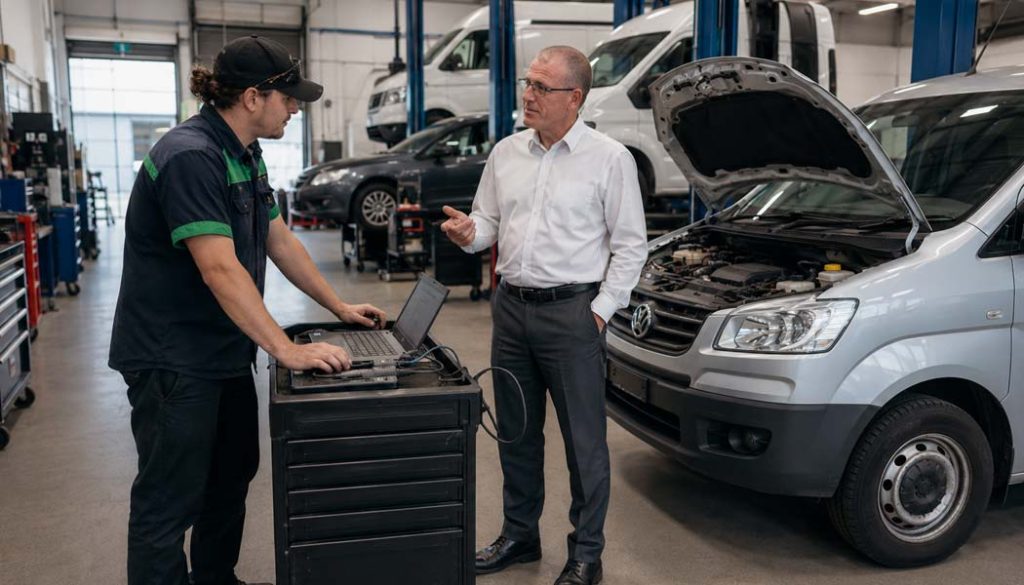
Specialist diagnostics is not just about having better equipment, though that matters. It is about having the training to interpret what the equipment returns. Fault codes tell you a component is outside its expected range. They do not always tell you why, or what triggered it, or what else in the network has been affected. That interpretation requires both the right tools and the experience to read the data in context.
For Peugeot and Citroën vans, our Peugeot and Citroën servicing uses manufacturer-level diagnostic software that accesses the full fault picture, including stored and pending codes, live data streams across all modules, and calibration status. This is the level of access that gives an accurate diagnosis rather than an educated guess.
Software Calibration and ECU Updates
ECU calibration is something many van owners do not think about until something goes wrong. Modern PSA platform vehicles receive software updates that affect fuel delivery, emissions management, transmission behaviour and sensor thresholds. A van running outdated ECU software may be operating outside its intended parameters without any warning light to indicate it. Calibration checks as part of a diagnostic inspection catch this.
Incorrect calibration after parts replacement is also a significant issue. Replacing a sensor or a module without recalibrating the ECU to recognise the new component is a common cause of recurring warning lights after a repair. The part is correct. The system does not know that yet.
Preventing Unnecessary Parts Replacement
One of the clearest practical benefits of proper diagnostics is avoiding unnecessary parts replacement. A workshop that clears a fault code without identifying its root cause will often replace the component the code points to. If that component is not actually the source of the problem, the fault returns. The owner pays for a part they did not need, and the repair is done again.
Accurate fault tracing from a full diagnostic scan identifies the actual source of the problem before any parts are ordered. On complex European van platforms, that discipline saves money consistently. For more on the parts question specifically, our post on genuine versus aftermarket parts covers the compatibility risks in detail.
If your van is showing recurring warning lights, intermittent electrical faults, or performance that is not quite right, a specialist diagnostic scan is the right starting point. Book with East Coast Commercial Service Centre in Acacia Ridge and get a complete picture of what your van's ECU is actually telling you.
Book a DiagnosticSigns Your Van May Need Professional ECU Diagnostics
Some of the most important warning signs are the ones that seem easy to live with. A warning light that cleared itself. A sluggish morning start that resolved once the engine warmed up. Fuel consumption that has drifted upward over the last few months. None of these individually demands urgent action. Together they suggest something is developing in the ECU or connected systems that a specialist scan would find.
The key principle is this: an ECU logs a fault code when a parameter falls outside its expected range. If the van has behaved in any way that seems unusual, that behaviour almost certainly has a corresponding stored code, even if the warning light never appeared or has since cleared. That code is still there, waiting to be read by the right equipment.
Reduced Engine Performance
Performance reduction in these vans is rarely sudden. It is gradual: a slight loss of responsiveness under acceleration, a subtle change in how the van handles a loaded run, a fuel consumption figure that used to be predictable and now varies. These changes happen slowly enough that drivers adapt to them without noticing the shift. A diagnostic scan that reveals a boost pressure sensor operating at the edge of its tolerance, or a fuel trim value running consistently lean, identifies the cause of that performance drift before it becomes a hardware failure.
Electrical Systems Behaving Inconsistently
Electrical inconsistencies, accessories that occasionally do not respond, charging behaviour that varies, interior systems that behave differently at different times, are almost always module communication issues. In a van that runs a BSI (Body Systems Interface) module alongside the engine ECU, those communication faults are common and consistently under-diagnosed by workshops without the right access. The fleet van diagnostics work we do regularly finds stored BSI faults that generic scans have missed entirely.
Early Diagnostics Help Prevent Larger Repair Costs
The repair cost hierarchy in European van maintenance is straightforward. A diagnostic scan costs a fraction of a component replacement. A component replacement costs a fraction of a system failure. A system failure costs a fraction of an engine rebuild. At every level, earlier intervention reduces cost, and the further back in that chain you can catch a problem, the better the outcome.
Preventive fault scanning, booked as part of a regular service schedule rather than in response to a warning light, is the most reliable way to stay ahead of that hierarchy. For fleet operators managing multiple vehicles, it also creates something valuable that reactive maintenance cannot: predictability. When you know the fault history of each vehicle in the fleet, you can plan maintenance rather than react to failures.
For Fiat Ducato owners dealing with a specific warning, our post on Fiat Ducato AdBlue warning lights covers one of the most common ECU-triggered alerts in detail.
Frequently Asked Questions
What does the ECU control in a modern van?
The ECU manages fuel injection timing, turbo boost pressure, emissions systems, transmission communication, engine temperature, battery charging and throttle response. On European vans like the Peugeot Boxer, Fiat Ducato and Citroën Relay, the ECU operates alongside connected modules including the BSI (Body Systems Interface), which controls additional vehicle functions. A fault in any part of this network can affect multiple systems simultaneously.
Why do ECU warning lights keep returning after repairs?
Recurring warning lights usually mean the root cause was not identified during the repair. A workshop that clears a fault code without tracing its source will see the same code return once operating conditions repeat. This is especially common when a generic scan tool was used, as it reads surface fault codes only and cannot access the deeper fault layers that identify the actual source of the problem.
Can generic scan tools diagnose Peugeot, Fiat and Citroën vans properly?
Not fully. Generic OBD2 readers access standardised universal fault codes, which represents a fraction of the data these vehicles hold. Peugeot and Citroën vans require Diagbox or Planet software. Fiat Ducato diagnostics need Multiecuscan or equivalent manufacturer-specific tools. Without these, BSI module data, ECU programming functions, stored fault history and live data streams remain inaccessible.
What causes ECU faults in commercial vans?
Common causes include sensor failures, wiring degradation, battery voltage irregularities, software that needs updating, DPF system overload, and communication errors between electronic modules. Stop-start urban driving accelerates several of these, particularly DPF and battery management faults, which is why Brisbane fleet vans operating on suburban routes need more frequent diagnostic attention than vehicles doing longer highway runs.
How often should a commercial van be diagnostically scanned?
At minimum, at every service interval. For high-utilisation vehicles doing daily Brisbane runs, more frequent scanning is worthwhile, particularly during summer when battery and cooling system stress is highest. The value of consistent scanning history is that it shows developing trends across multiple readings, not just the snapshot from a single visit.
East Coast Commercial Service Centre specialises in Fiat, Peugeot and Citroën commercial van servicing at our workshop in Acacia Ridge, Brisbane. Whether your van needs a full diagnostic scan, a specific fault traced, or a scheduled service with manufacturer-level electronic checking, our team has the tools and experience to get it right. Book a service online or call us on (07) 3276 4733.
Other posts you will find helpful