Van Suspension Problems Brisbane: How Heavy Loads Destroy Commercial Van Suspension
Van suspension problems in Brisbane fleet vans develop quietly and expensively. Heavy loads, stop-start delivery routes, Brisbane's subtropical climate and variable road surfaces all combine to accelerate suspension wear far beyond what manufacturer intervals predict. This post covers exactly how load stress damages suspension components, what the warning signs look like in practice, and what the inspection schedule should be for Fiat, Peugeot and Citroën commercial vans in heavy commercial use.
Steering and suspension was among the top five defect categories in the NHVR's 2024 National Roadworthiness Survey, which inspected 9,082 commercial vehicles across Australia. That is not a surprising finding to anyone who works on these vehicles regularly. Suspension wear is insidious precisely because it happens gradually. Drivers adapt to the slowly worsening ride without noticing how far handling has drifted from where it started.
By the time something feels obviously wrong, multiple components are usually involved. The repair scope at that point is considerably larger than it would have been six months earlier.
For Fiat Ducato, Peugeot Boxer and Citroën Relay operators, the problem is compounded by the way these vans are typically used. Near-capacity loads, repeated daily use, and Brisbane's urban route conditions create a maintenance challenge that standard service intervals were not specifically designed to address.
Why Commercial Van Suspension Takes More Punishment Than Car Suspension
The engineering difference between passenger car and commercial van suspension is significant. A passenger car is tuned primarily for ride comfort under light, predictable loads. A commercial van like the Fiat Ducato or Peugeot Boxer is designed to handle substantial payload weights, repeatedly, across long operating lives. Springs are stiffer. Shock absorbers are rated for heavier work. The overall geometry is set up to maintain stability under load.
But even heavy-duty components have limits. Those limits are defined by the manufacturer's rated payload and the expected operating conditions. When a van consistently operates at or near maximum payload, or when it does so on road surfaces that generate constant impact stress, those limits are tested daily.
What Actually Happens to Suspension Components Under Repeated Load
Springs compress further than designed when a van is heavily loaded. Over time, repeated full compression causes the spring to take a permanent set, meaning it no longer returns to its original height when unloaded. The van sits lower. Suspension travel is reduced. The geometry shifts.
Shock absorbers cycle through their full range of motion more often under heavy loads, and with greater force. The internal fluid and valving wear at an accelerated rate. A shock absorber that might last 80,000 kilometres in light use may need replacement at 40,000 to 50,000 kilometres in daily commercial operation.
Bushings, the rubber or polyurethane sleeves that cushion connection points throughout the suspension, are particularly vulnerable. They harden and crack under the combined pressure of load stress and heat. Brisbane's subtropical climate accelerates this specifically, as high ambient temperatures cause rubber to degrade faster than in cooler conditions.
How Overloading Changes the Damage Profile
Operating a van beyond its rated payload does not just accelerate wear. It changes the nature of the damage. Mounting points, the locations where suspension components bolt to the chassis, can develop stress fractures or elongated bolt holes when loads are consistently excessive. This kind of structural damage is more serious than component wear because it affects the integrity of the attachment point, not just the component itself.
Operating beyond rated payload also carries warranty implications. Most manufacturer warranties for suspension and related components exclude damage caused by consistent overloading. Staying within the rated Gross Vehicle Mass is both a safety and a commercial decision.
Suspension wear is the one thing that drivers adapt to without realising it. The van handles a little differently each week, and by the time it feels obviously wrong, the job is usually twice the size it would have been.
The Brisbane Factor: Why Local Conditions Accelerate Suspension Wear
Brisbane's road network creates specific challenges for commercial van suspension. Urban delivery routes through areas like Acacia Ridge, Logan, Ipswich and the inner south involve frequent stopping and starting, speed humps designed for residential traffic rather than loaded commercial vehicles, variable road quality, and kerb approaches that generate lateral impact stress on suspension components.
Speed humps deserve particular mention. A Fiat Ducato at maximum payload crossing a speed hump at anything above a crawl generates significant suspension impact. Repeated daily across multiple humps on multiple routes, the cumulative load on springs, shock absorbers and bushings is substantial.
Heat and Rubber Degradation in Queensland
Brisbane's subtropical climate is hard on rubber. Bushings, seals and flexible suspension components all degrade faster under sustained high ambient temperatures than they would in Sydney or Melbourne. A bushing that might last five years in a cooler climate may crack and harden in three in Queensland conditions, particularly in a van that spends long periods parked in direct sun between delivery runs.
This is not a reason to panic about suspension, but it is a reason to inspect rubber components specifically at every service rather than waiting for a symptom to appear. A cracked bushing is an inexpensive fix. The misalignment and secondary wear it causes if left in place is not.
Regional Routes and Higher-Speed Suspension Stress
Vans running regional routes to the Gold Coast, Sunshine Coast or out toward Ipswich encounter higher sustained speeds, which amplify the effect of any existing suspension wear. A shock absorber that feels adequate at urban speeds becomes noticeably inadequate at 100 km/h when the van is loaded. Handling becomes vague, cornering stability decreases and braking distances extend. These effects are not always obvious until the van is tested under the conditions that reveal them.
Warning Signs: What Suspension Wear Actually Feels and Sounds Like
Most suspension warning signs are subtle enough at first that they are easy to attribute to something else or simply ignore. The challenge is that the van usually remains drivable throughout most of the wear progression, which creates a false sense that nothing serious is wrong.
| Warning Sign | Most Likely Cause | Secondary Risk if Ignored | Action Required |
|---|---|---|---|
| Excessive bounce after speed humps | Worn shock absorbers | Increased stopping distances, tyre wear | Shock absorber inspection |
| Van sitting lower at rear than usual | Sagged or broken springs | Geometry shift, uneven brake bias | Spring assessment immediately |
| Pulling to one side under braking | Worn bushings, alignment drift | Uneven tyre wear, brake stress | Alignment and suspension check |
| Clunking or knocking from underneath | Loose or cracked mounts, worn bushings | Component separation risk | Workshop inspection, do not delay |
| Uneven tyre wear across tread | Alignment drift from suspension wear | Premature tyre failure, blowout risk | Alignment check and tyre rotation |
| Vague or loose steering feel | Worn steering and suspension components | Reduced vehicle control under load | Full steering and suspension assessment |
| Harsh ride on smooth roads | Collapsed bushings or failed dampers | Accelerated wear on adjacent components | Suspension component inspection |
Tyre Wear as an Early Warning System
Tyre wear patterns are one of the most reliable early indicators of suspension problems, precisely because tyres record what is happening to the suspension over thousands of kilometres rather than at a single point in time. Feathering across the tread surface indicates toe misalignment. Heavy wear on one edge points to camber issues caused by suspension component wear or geometry shift. Cupping patterns, where the tyre develops an irregular scalloped surface, almost always indicate worn shock absorbers that are allowing the tyre to bounce rather than maintain consistent road contact.
Checking tyre wear at every service takes thirty seconds and provides information that no visual suspension inspection alone can replicate. It is worth doing systematically rather than waiting for a tyre to look visibly worn.
Visual Signs That Are Easy to Miss
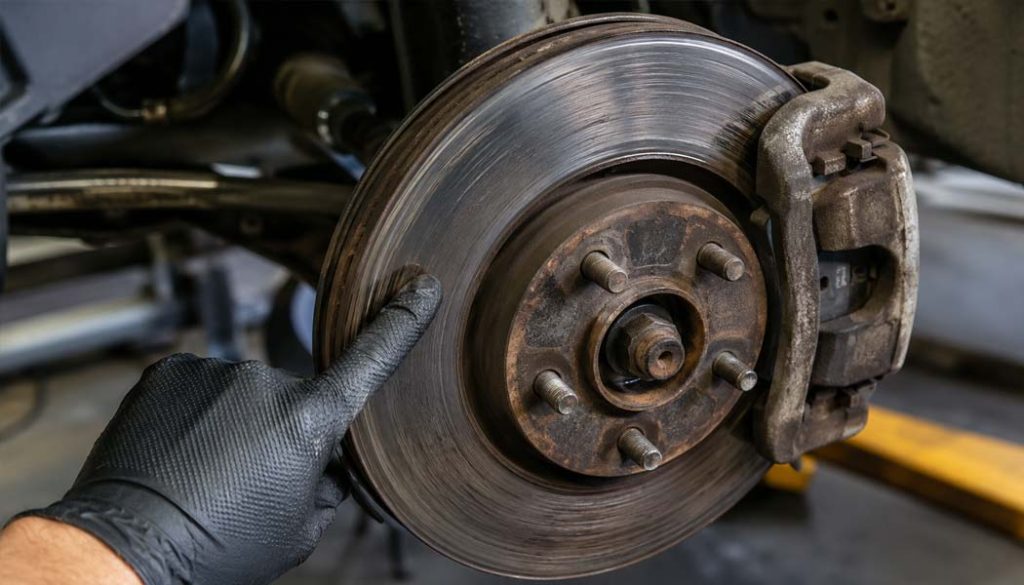
Oil leaking from a shock absorber body is a definitive sign that the unit needs replacement. It is also a sign that is frequently missed because shock absorbers are not somewhere most drivers or non-specialist technicians look routinely. Cracked rubber bushings are visible under the vehicle if looked for specifically. Components that appear slightly out of their designed position are worth noting even if they have not yet caused a symptom.
Any van that has had a significant impact, a deep pothole strike, a kerb hit or a minor collision, should be inspected for suspension damage even if it drives normally afterwards. Some suspension damage affects geometry without producing immediate symptoms. The consequences show up weeks later as accelerated tyre wear or an alignment that will not hold.
We regularly see vans where the driver has no idea anything is wrong, but the tyres are telling a completely different story. Cupped rear tyres, feathering on the fronts. The suspension has been wearing for months. The tyres are just the evidence.– Neville Wall, East Coast Commercial Service Centre
How Suspension Wear Cascades Into Larger Problems
Suspension components do not wear in isolation. When one part deteriorates, the stress it was absorbing is redistributed to adjacent components. A worn shock absorber allows more spring movement, which accelerates spring fatigue. A cracked bushing allows components to move outside their designed range, which puts stress on mounting points and accelerates wear in connected steering components.
The cascade effect is what makes deferred suspension maintenance expensive. A shock absorber replacement is a predictable, manageable cost. Shock absorber replacement plus spring replacement plus bushing replacement plus wheel bearing replacement, which is what often accompanies severely worn suspension, is a significantly different conversation.
The Connection Between Suspension and Brake Performance
Worn suspension directly affects braking. Shock absorbers that cannot control wheel movement allow tyres to briefly lose contact with the road surface during braking, which reduces the traction available for stopping. In a fully loaded van braking hard, the difference between a suspension system in good condition and one with worn dampers can be measured in metres of stopping distance. This is not a theoretical concern. It is a documented effect that is particularly significant in heavy commercial vehicles.
The electronic brake systems in modern Fiat, Peugeot and Citroën vans also rely on stable suspension geometry to function correctly. ABS, electronic brakeforce distribution and stability control all make calculations based on wheel speed sensor data that assumes the vehicle is behaving within its designed parameters. Significantly worn suspension puts the vehicle outside those parameters in ways the electronic systems were not designed to compensate for fully.
Does Your Van Need a Suspension Inspection?
Work through the checklist below. Three or more ticks indicates a suspension inspection is overdue rather than optional.
Suspension Inspection Intervals for Commercial Vans
There is no universal correct interval for commercial van suspension inspection. Manufacturer guidelines provide a framework but were not written specifically for a van doing heavy daily delivery work in subtropical Queensland conditions. The operating profile has to inform the schedule.
| Operating Profile | Recommended Suspension Check | Bushing Inspection | Full Assessment |
|---|---|---|---|
| Light use, mostly highway, low load | Every scheduled service | Every 2 years | Every 40,000-50,000 km |
| Mixed urban and highway, moderate load | Every scheduled service | Every 18 months | Every 25,000-30,000 km |
| Heavy urban, high load, daily use | Every service or 6 months | Every 12 months | Every 15,000-20,000 km |
| Maximum payload, construction or trades | Every 3-4 months | Every 10,000 km | Every 10,000-12,000 km |
Wheel alignment deserves a specific note. Many operators treat alignment as a tyre service item rather than a suspension item. It is both. Alignment that has drifted as a result of suspension wear will not hold after a simple alignment check if the underlying components have not been addressed. The alignment is a symptom of the suspension condition, not an independent problem.
The AL-KO Front Suspension Upgrade for Fiat Ducato
For Fiat Ducato operators regularly carrying loads at or near the vehicle's maximum payload rating, the AL-KO front suspension upgrade is worth serious consideration. It is an aftermarket system that replaces the standard front suspension components with a heavier-duty alternative specifically engineered for higher payload stress.
The standard Ducato front suspension is well designed for a wide range of uses, but it was not specifically optimised for operators running at maximum GVM repeatedly. The AL-KO system addresses this with upgraded components that handle the thermal and mechanical stress of high-payload operation more effectively over time.
For operators using their Ducato as a motorhome base, or for trades operators whose van is consistently at maximum payload, the upgrade reduces long-term suspension wear, improves handling stability under load and extends the service life of adjacent components. More detail is available on our Fiat Ducato AL-KO front suspension upgrade page.
If your van is showing any suspension warning signs, or it has been more than 12 months since a dedicated suspension inspection, do not defer it. Book with East Coast Commercial Service Centre in Acacia Ridge for a suspension assessment by technicians who know these platforms specifically.
Book a Suspension InspectionGenuine Parts and Why They Matter for Suspension
Suspension components are not an area where budget alternatives perform well over time. Aftermarket shock absorbers and bushings may match the specification on paper but rarely match the durability or the fit precision of manufacturer parts. On a van running near its payload limit daily, a substandard bush that begins to compress unevenly or a shock absorber that loses its damping characteristics at high operating temperatures creates problems faster than the cost saved on the cheaper part.
The PSA platform shared by the Boxer, Relay and Ducato has specific suspension geometry requirements that depend on components behaving within tight tolerances. For more on the parts question generally, our post on genuine versus aftermarket parts covers the compatibility and durability considerations in detail.
Preventive Suspension Maintenance Reduces Total Fleet Cost
For operators running more than one van, suspension maintenance managed preventively rather than reactively produces measurable cost differences over time. Tyre replacement frequency decreases when alignment is maintained. Component replacement is planned rather than emergency. Downtime is scheduled rather than forced at the worst possible moment.
A van with well-maintained suspension also handles more predictably under heavy load and in the kind of emergency braking and evasive manoeuvre situations that happen unexpectedly in commercial driving. That handling confidence has a direct bearing on driver safety, not just component longevity.
Our commercial vehicle servicing at Acacia Ridge includes suspension inspection as a standard item at every service, with the specialist knowledge of Fiat, Peugeot and Citroën platform-specific suspension requirements that generic workshops often lack.
Frequently Asked Questions
How do I know if my van's suspension is damaged from heavy loads?
The most reliable early indicators are tyre wear patterns, not handling feel. Cupping on the rear tyres indicates worn shock absorbers. Feathering across the tread indicates toe misalignment from geometry drift. Edge wear indicates camber issues. Beyond tyres, excessive bounce after speed humps, a van that sits lower at the rear than it used to, and clunking sounds from underneath are all signals worth acting on rather than monitoring.
Is it safe to keep driving with suspected suspension damage?
It depends on the symptom. A clunking noise that developed recently warrants an inspection before the next long trip or heavy load run. A van that is sitting noticeably lower at the rear, pulling to one side under braking, or exhibiting vague steering should be inspected promptly. Worn suspension directly affects braking distances and handling stability under load, both of which are safety-critical in a commercial van. The risk is higher than most drivers assume because the decline is gradual and easy to underestimate.
What does a suspension inspection cost for a Fiat Ducato or Peugeot Boxer in Brisbane?
A visual suspension inspection as part of a scheduled service carries no additional cost at East Coast Commercial. A standalone dedicated suspension assessment is straightforward to quote once the scope is clear. Shock absorber replacement, spring replacement and bushing replacement all carry different price points depending on which axle and how many components are involved. The most accurate way to know what your van needs and what it will cost is to book an inspection so the exact condition of each component can be assessed before any parts are ordered.
Does overloading a van void the suspension warranty?
Yes, in most cases. Manufacturer warranties for suspension components typically exclude damage caused by operation beyond the vehicle's rated Gross Vehicle Mass. This applies to springs, shock absorbers, bushings and mounting points. Consistently operating above the rated payload is considered misuse under most warranty agreements. Staying within the rated GVM and servicing on schedule are the most reliable ways to keep warranty coverage intact.
What is the AL-KO suspension upgrade and who should consider it?
The AL-KO front suspension upgrade is an aftermarket system designed specifically for the Fiat Ducato that replaces standard front suspension components with heavier-duty alternatives. It is particularly suited to operators who regularly carry loads at or near the vehicle's maximum payload rating, and to motorhome operators where the Ducato chassis carries significant fitted weight. The upgrade improves handling stability under load, reduces wear on the standard components and extends the service life of adjacent steering and suspension parts. We fit and supply this system at our Acacia Ridge workshop.
East Coast Commercial Service Centre specialises in Fiat, Peugeot and Citroën commercial van servicing at our workshop in Acacia Ridge, Brisbane. Suspension inspections are included at every service visit, and we supply and fit the AL-KO front suspension upgrade for Fiat Ducato operators requiring a heavier-duty solution. Book online or call us on (07) 3276 4733.
Other posts you will find helpful